Strength training for beginners at home does not require a complicated split, a room full of equipment, or an exhausting first session. Start with a few repeatable movement patterns, train the whole body twice per week, and increase the challenge gradually as your technique and recovery improve.

Beginners can start strength training at home with two full-body sessions per week and a small set of repeatable exercises.
How to Start Strength Training at Home
Your first goal is not to lift as much as possible. It is to learn exercises you can repeat with control, record what you did, and return for the next session without feeling overwhelmed.
A beginner strength training routine at home should cover five basic patterns: squat, hinge, push, pull, and core control. These patterns train the major areas of the body without requiring a long list of exercises.
Before Your First Workout
- Clear enough floor space to squat, step back, lie down, and extend your arms.
- Choose a stable chair, counter, bench, or other surface before the workout begins.
- Prepare a mat if floor exercises are uncomfortable on your flooring.
- Select an easier and a harder version of each exercise so you can adjust during the session.
- Open a notebook or phone note for sets, repetitions, exercise variations, and effort.
Measure the area you will use while moving, not only the space where equipment is stored. This home gym space guide explains how to plan active workout clearance.
Your First Full-Body Workout
Begin with three to five minutes of easy movement, such as marching in place, gentle arm circles, and a few comfortable bodyweight squats. Then complete the following workout:
- Chair squat: 1–2 sets of 8–10 repetitions
- Glute bridge: 1–2 sets of 8–12 repetitions
- Incline push-up: 1–2 sets of 6–10 repetitions
- One-arm backpack row or securely anchored band row: 1–2 sets of 8–10 repetitions per side
- Dead bug: 1–2 sets of 5–8 controlled repetitions per side
Rest long enough to begin the next set without rushing. For the first few sessions, choose a variation that feels moderately challenging and leaves approximately two or three controlled repetitions available at the end of the set. That is a practical coaching cue, not a mandatory threshold.
Stop the set when you cannot maintain the intended movement, have to speed through the repetition, or experience sharp or concerning discomfort. Persistent pain, dizziness, or symptoms that change how you move should not be treated as normal training fatigue.
The 5 Movement Patterns Every Beginner Program Should Cover
The five movement patterns give beginners a practical foundation. They are categories, not the only five exercises a person will ever need.
|
Movement Pattern |
Beginner Options |
What It Trains |
|
Squat |
Chair squat, bodyweight squat |
Legs, hips, and standing control |
|
Hinge |
Glute bridge, hip-hinge drill |
Glutes, hamstrings, and hip movement |
|
Push |
Wall push-up, incline push-up, floor press |
Chest, shoulders, and triceps |
|
Pull |
Backpack row, band row, cable row |
Upper back, arms, and shoulder control |
|
Core control |
Dead bug, plank, side plank |
Trunk stability and control |
Squat
A squat teaches you to lower and raise your body with control. A chair can provide a clear target while you learn a comfortable depth. Keep your feet stable and let your knees travel in a direction that feels natural and controlled.
Hinge
A hinge emphasizes movement at the hips. Glute bridges are a simple starting option before loaded hip hinges or Romanian deadlifts. The goal is to move through a comfortable range without forcing the lower back to create the motion.
Push
Incline push-ups let you adjust difficulty by changing the height of the surface. A higher surface is usually easier; a lower surface is usually harder. Choose a sturdy setup that does not slide.
Pull
A beginner program should include pulling as well as pushing. A loaded backpack row, resistance-band row, or cable row can train the upper back. Only use an anchor or piece of furniture that is designed or securely positioned for the direction of force.
Core Control
Core training should teach you to control the trunk while the arms or legs move. Dead bugs, planks, and side planks can all work, but the best variation is the one you can perform without holding your breath or losing your position.
The same movement categories can be used by women and men, while exercise selection, resistance, and weekly volume should be individualized. For a program tailored specifically to women, see this guide to strength training for women.

How Often Should a Beginner Strength Train?
Two full-body sessions per week are a practical starting point. Current CDC physical activity guidance recommends muscle-strengthening activity on at least two days per week, and the 2026 ACSM resistance training guidance emphasizes training the major muscle groups at least twice weekly and prioritizing consistency over unnecessary complexity.
A third weekly session is optional. Add it only when two sessions feel manageable, soreness does not interfere with normal movement, and the extra session fits your schedule. You do not have to reach three days by a specific week.
Many beginners find it easier to recover when full-body sessions are separated by a rest or light-activity day. A Monday–Thursday or Tuesday–Saturday schedule works well, but the exact days matter less than maintaining a repeatable pattern.
Walking, easy cycling, or moderate cardio can remain in the week. Keep those sessions appropriate to your current fitness and avoid turning every day into a hard workout.
Can You Start Strength Training at Home Without Equipment?
Yes. Strength training at home without equipment can begin with chair squats, glute bridges, incline push-ups, step-ups, wall sits, dead bugs, and planks. A backpack, water containers, or resistance bands can add load when bodyweight variations become easy.
Bodyweight training can be enough at first, but the exercises must become more challenging as strength improves.
You can increase difficulty by adding repetitions, using a harder variation, slowing the lowering phase, adding a pause, increasing the range of motion you can control, or adding external resistance. Change one variable at a time so you know what caused the workout to become harder.
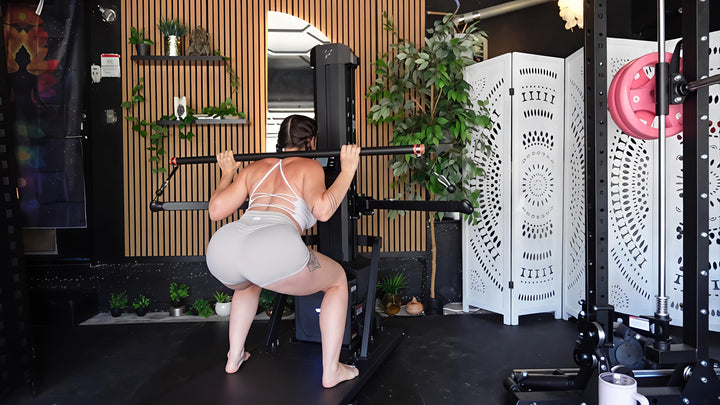
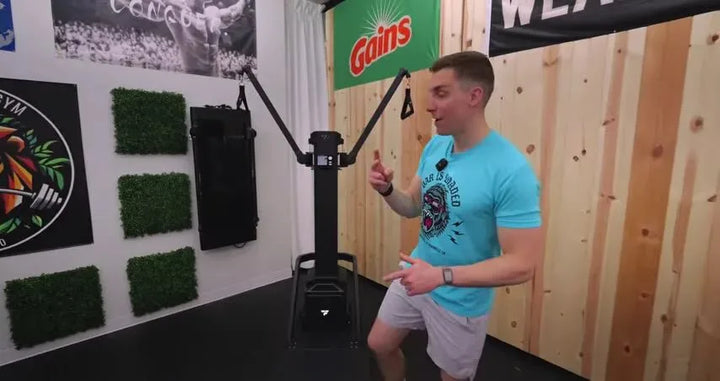
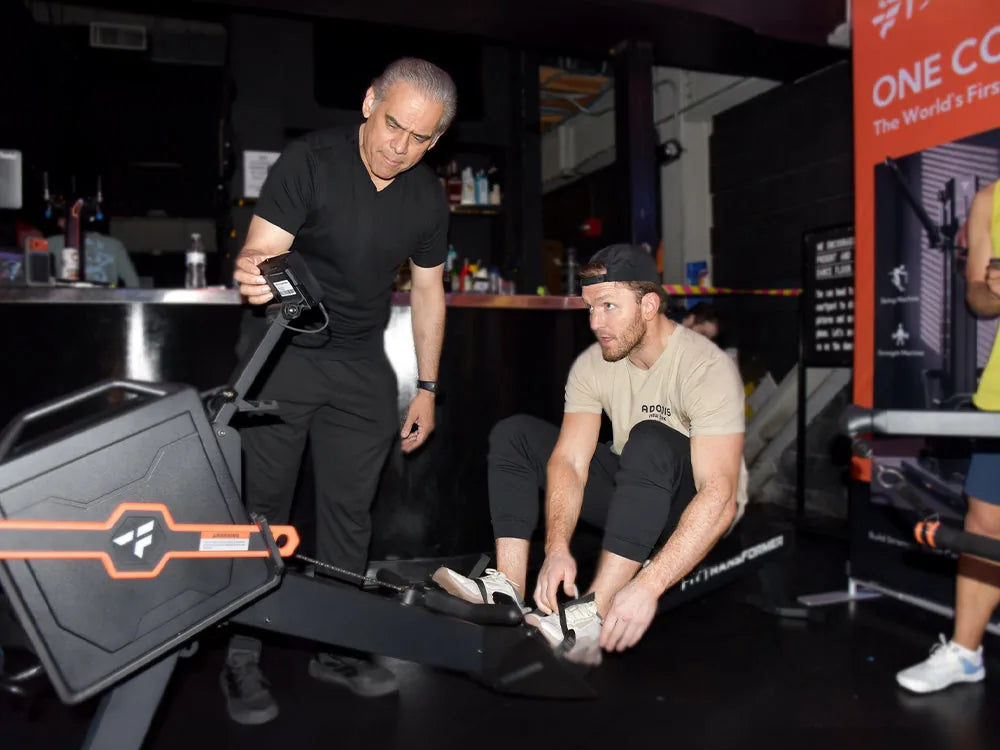
A digitally controlled cable system is another later-stage option when a user wants adjustable resistance and multiple movement patterns from one station. The FitTransformer Titan, for example, provides digitally controlled resistance, supports more than 200 listed movements, and folds for storage. It also requires electrical power, enough active training space, and a larger purchase commitment than bands or adjustable dumbbells. This does not make a home training system necessary for beginners; it simply provides another way to adjust resistance as the routine progresses. The relevant question is whether those features solve a real space or progression problem.

Your 8-Week Beginner Strength Training Program
This eight-week strength training plan for beginners is an adaptable framework, not a guaranteed transformation program. Keep the main movements consistent long enough to learn them, but adjust the exercise variation, number of sets, or weekly frequency when recovery or ability requires it.
The first eight weeks should prioritize movement quality, consistency, and gradual progression rather than maximum weight.
|
Weeks |
Main Goal |
Training Plan |
|
1–2 |
Learn the movements |
2 full-body sessions; 1 set of most exercises |
|
3–4 |
Build a repeatable routine |
2 full-body sessions; add a second set where appropriate |
|
5–6 |
Add a measurable challenge |
2–3 sessions; add repetitions, resistance, or a harder variation |
|
7–8 |
Practice simple progression |
2–3 sessions; alternate Workout A and Workout B |
Weeks 1–2: Learn the Movements
Repeat the same full-body workout twice per week. Begin with one set of each exercise and add a second set only when the first set feels controlled and recovery is manageable.
- Chair squat: 8–10 repetitions
- Glute bridge: 8–12 repetitions
- Incline push-up: 6–10 repetitions
- Backpack, band, or cable row: 8–10 repetitions per side
- Dead bug: 5–8 repetitions per side
Use a shorter range of motion or an easier variation when needed. The objective is to make each repetition look similar, not to chase fatigue.
Weeks 3–4: Build a Repeatable Routine
Continue with the same core exercises and add a second set to movements that feel stable. Keep most exercises within a manageable range such as 6–12 repetitions, without treating that range as the only effective option.
- Use the same exercise variation long enough to compare sessions.
- Add repetitions before adding load when the current variation is still challenging.
- Record which movements feel stable and which need an easier setup.
- Keep two weekly sessions if recovery is still demanding.
You may notice better coordination, smoother repetitions, or greater confidence before visible physique changes. Those are meaningful signs that the routine is becoming more familiar.
Weeks 5–6: Add One Progression Variable
Choose one way to make each exercise harder: add repetitions, add a set, use a harder variation, slow the lowering phase, or increase resistance. Avoid changing several variables at once.
- Squat or split-squat pattern: 2–3 sets
- Glute bridge or hip-hinge pattern: 2–3 sets
- Push variation: 2 sets
- Pull variation: 2 sets
- Dead bug, plank, or side plank: 2 sets
Add a third weekly session only when the current two-session plan feels sustainable. The third day can repeat the same routine at slightly lower volume rather than introducing a completely new workout.
Weeks 7–8: Use a Simple A/B Routine

Alternating two full-body workouts adds variety while keeping the movement categories familiar. Train twice weekly or add a third session when recovery and schedule allow.
|
Workout A |
Workout B |
|
Chair squat or bodyweight squat |
Step-up or supported split squat |
|
Glute bridge |
Hip-hinge variation |
|
Incline push-up |
Floor press or overhead press variation |
|
Backpack, band, or cable row |
Pulldown or alternative row |
|
Dead bug |
Side plank |
For two weekly sessions, alternate A and B. For three weekly sessions, use A–B–A in one week and B–A–B in the next. Most sets should remain challenging but controlled rather than reaching muscular failure.
How to Use Double Progression
Double progression gives a beginner strength training program a simple rule for adding difficulty. Choose a repetition range, such as 8–12 repetitions, and keep the exercise variation and resistance consistent while you build toward the top of that range.
- Start with a resistance or exercise version you can control near the lower end of the range.
- Add one or two repetitions over later sessions while technique remains stable.
- When you can reach the top of the range across the planned sets, add a small amount of resistance or choose a slightly harder variation.
- Return to the lower end of the repetition range and build again.
This is one form of progressive overload at home. Progress can also come from improved control, a larger comfortable range of motion, or an additional set when appropriate.
What to Do About Soreness, Recovery, and Missed Workouts
If You Are Sore
Mild muscle soreness can occur when an exercise is new or the workload increases, but soreness is not required for a workout to be effective. Consider an easier session, a different movement pattern, or another recovery day when soreness meaningfully limits normal movement.
Sharp pain, swelling, dizziness, numbness, or persistent symptoms should not be treated as ordinary soreness. Stop the activity and seek appropriate professional guidance when symptoms are concerning or do not settle.
If You Miss One Workout
Do not restart the eight-week plan after one missed session. Continue with the next planned workout and keep the usual sequence.
If You Miss a Week or Longer
Resume with the same exercises but temporarily reduce sets, resistance, or difficulty. Build back toward the previous workload over the next few sessions instead of trying to "make up" all missed training at once.
How to Know Whether You Are Making Progress
Progress is not limited to visible muscle or a heavier weight. In the first weeks, improvements can partly reflect better coordination and neural adaptation, including more effective motor-unit recruitment. A 4-week strength-training neural adaptation study supports that mechanism, but it should not be used to promise the same timeline for every beginner.
Progress is better measured through cleaner repetitions, higher resistance, and consistent training than through soreness alone.
Track the following:
- The date and workout completed
- Exercise variation
- Sets and repetitions
- Resistance or household load used
- Approximate effort
- A brief note about control, balance, or discomfort
Look for trends across several sessions. Cleaner technique, more repetitions at the same resistance, a harder variation, better stability, or more consistent attendance can all indicate progress.
What to Do After Your First Eight Weeks
Eight weeks is not an expiration date for the program. Continue using the same basic routine when the exercises are still progressing, the schedule remains realistic, and the movement patterns match your goals.
Add exercises only for a clear reason, such as training a movement that is missing, addressing a specific goal, or making the plan more practical. Do not replace the entire routine simply because the calendar reached week eight.
Before buying more equipment, decide whether the next step is more repetitions, a harder variation, an extra set, or additional resistance. For a shorter ongoing format, this 30-minute full-body workout guide can help you organize the same movement patterns into a time-efficient session.
FAQs
How Many Days a Week Should a Beginner Strength Train?
Two full-body sessions per week are a practical starting point and align with public-health guidance to strengthen the major muscle groups on at least two days weekly. A third session is optional when recovery, schedule, and exercise tolerance allow it. For a more detailed breakdown, this guide on training frequency for beginners covers the key considerations.
How Many Sets and Reps Should a Beginner Start With?
One or two sets per exercise are enough to begin practicing a routine. Many exercises can start around 6–12 controlled repetitions, but the exact number should match the movement and the person. Stop before technique breaks down rather than forcing a target number.
Can Beginners Build Muscle at Home Without Equipment?
Yes. Bodyweight exercises and household loads can provide enough challenge for many beginners. Muscle-building progress still requires the exercises to become more demanding over time through repetitions, harder variations, added sets, slower tempo, or external resistance.
How Do You Know When to Increase Resistance?
Increase resistance when you can reach the top of your planned repetition range across all sets with controlled technique and without the last repetitions becoming rushed. After increasing resistance, return to the lower end of the repetition range and build upward again.
Should You Strength Train When Your Muscles Are Still Sore?
It depends on how the soreness affects movement. Mild soreness may allow normal or lighter activity, while soreness that meaningfully restricts range of motion or changes technique may justify an easier session or more recovery. Sharp, persistent, or concerning symptoms require a different response than ordinary muscle soreness.
How Long Does It Take to Notice Progress From Strength Training?
The timeline varies. Some beginners notice better coordination, more controlled repetitions, or improved exercise confidence within the first several weeks, while visible changes can take longer. Use workout records and trends across several sessions rather than expecting a guaranteed result by a fixed date.