A compact home gym is only useful when it can handle the movements you actually train, fit the room you have, and avoid turning every workout into a setup project. The FitTransformer Titan approaches that problem with motor-driven cable resistance, adjustable arms, and a folding platform in a freestanding design. It offers much of the exercise range associated with a functional trainer while removing the weight stacks, wall mounting, and recurring subscription that define many alternatives.

What the FitTransformer Titan Is
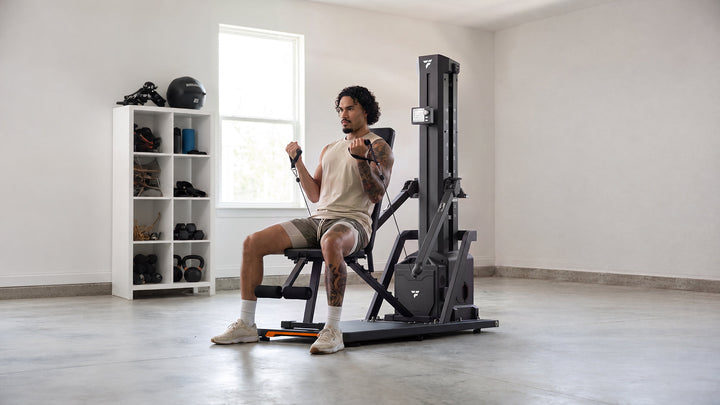
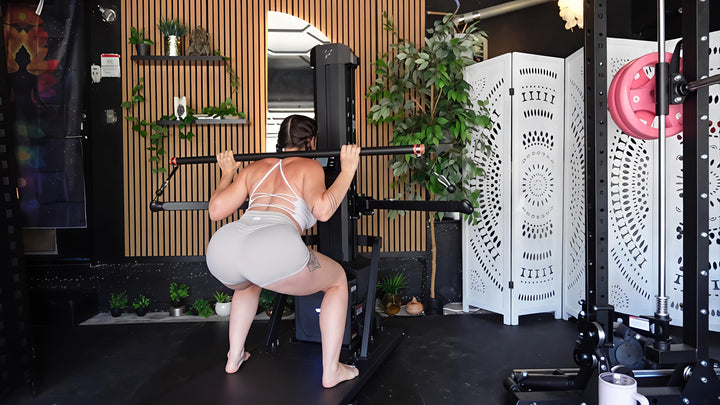
The Titan is an electronic functional trainer built around a removable resistance unit. In strength mode, it behaves like a dual-cable machine for presses, rows, pulldowns, squats, curls, and accessory work. A separate ski setting changes the resistance behavior so the arms can be positioned for ski-style conditioning. This combination gives buyers a way to cover cardio and strength training without reserving floor space for two full-size machines.
The source review positioned the machine at $2,399 at the time of filming. That price should be verified before publication, but it explains the intended market: buyers comparing a FitTransformer Titan home gym machine with a midrange weight-stack functional trainer or a higher-priced connected system. The Titan does not center its experience on coaching classes, app integrations, or a large media display. Its value comes from resistance capacity, adjustability, and a relatively simple ownership model.
The removable core also creates a modular path. It can stay installed in the Titan frame, or it can move between compatible FitTransformer modular frames and the FitTransformer SAIL rowing machine. That flexibility matters most to buyers who expect to expand one training system over time rather than purchase several unrelated machines.
Resistance Capacity and Training Modes
The stated maximum resistance is 264 lb total, or about 132 lb per side when the load is divided evenly. Electronic resistance does not feel identical to iron plates moving through a pulley ratio, so the number should not be treated as a direct promise that every lift will feel the same as a traditional stack. It does, however, provide enough range for many common upper-body, lower-body, and full-body cable exercises.
That range is particularly useful for buyers comparing cable machines and free weights. A cable system keeps tension through more of an exercise path and allows the pulling angle to change without moving a heavy frame. Free weights remain useful for other training goals, but the Titan can consolidate a broad selection of movements into one station. For general programming, public-health guidance recommends muscle-strengthening work at least two days per week, and a multi-angle cable station can make that schedule easier to organize at home.

How the Four Resistance Modes Differ
- Regular mode: provides the closest experience to conventional cable resistance for familiar sets and repetitions.
- Burst mode: emphasizes the lifting phase and reduces resistance on the return, which can support faster concentric work.
- Centrifugal mode: shifts more resistance to the return phase. Eccentric muscle actions occur while a muscle lengthens under load, so this setting can change the challenge without changing the movement itself.
- Auxiliary mode: reduces resistance when cable movement stalls, functioning as an electronic assistance option during demanding repetitions.
The interface also asks whether a movement uses one handle or two. In two-handle training, the selected total is divided across both sides. That extra menu step can feel less immediate than moving a selector pin, but it makes the displayed load easier to interpret once the user understands the convention.
Footprint and Small-Space Setup
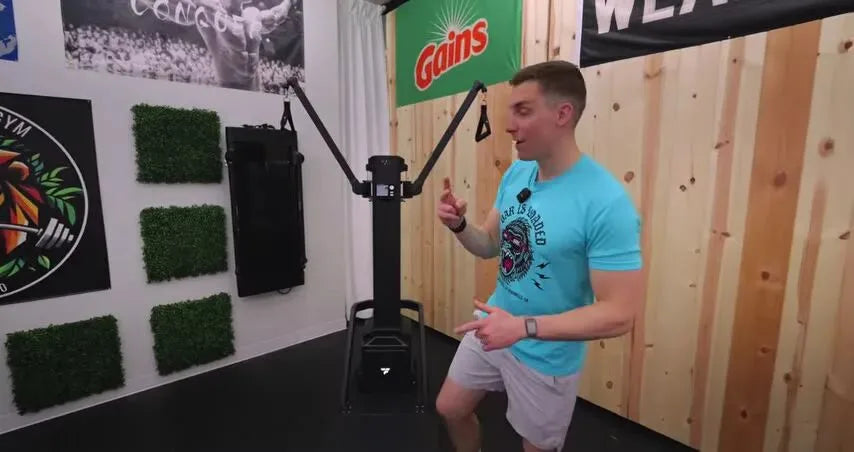
The freestanding frame is a practical distinction for renters and owners who do not want to drill into a wall. The platform folds vertically, the arms lower against the frame, and small wheels let the unit shift within a room. In the source test, moving it a few feet was manageable, although it did not roll as freely as light portable equipment.

The video identifies a folded footprint of approximately 27 by 30 inches. That figure describes storage rather than the full exercise zone. Cable paths, extended arms, a user's stance, and an adjustable bench all need additional clearance. A realistic plan should measure both the stored footprint and the working footprint, then account for the longest movements in the program. A guide to how much space a home gym needs can help turn those measurements into a practical room layout.
Leveling feet are another useful detail. They allow the platform to sit more securely on a slightly uneven gym floor, but they do not replace a stable, suitable surface. Before loading the cables, check that the platform is fully lowered, the frame does not rock, and the power cord cannot cross the exercise path.
Adjustable Arms and Exercise Range
Each arm offers three kinds of adjustment: vertical position, front-to-back angle, and an additional up-and-down angle at the arm. The numbered height track runs from low positions for deadlift patterns and curls to high positions for pulldowns and triceps work. Multiple horizontal and vertical angles help the cable line match presses, fly variations, rows, and unilateral exercises more closely than a fixed pulley can.

The important operating detail is that resistance must be disengaged before moving an arm. On a mechanical trainer, a user may be accustomed to sliding a pulley while a weight is selected. With the Titan, returning to the inactive state before adjustment prevents the motor from holding tension while the carriage moves. Proper strength-training technique matters more than selecting the heaviest available resistance, and careful setup is part of that technique.
A bench is not included in the reviewed package, although the source demonstration used one for several movements. Buyers planning seated presses, supported rows, or bench-based work should include a compatible FitTransformer adjustable bench in the space and budget calculation.
Controls, Attachments, and Daily Use
The detachable screen is intentionally basic. A rotary control moves through the machine choice, strength or ski mode, resistance mode, handle count, and load. This is a better match for someone who already has a program than for someone who expects on-screen coaching. It also avoids making the hardware dependent on a paid class library.
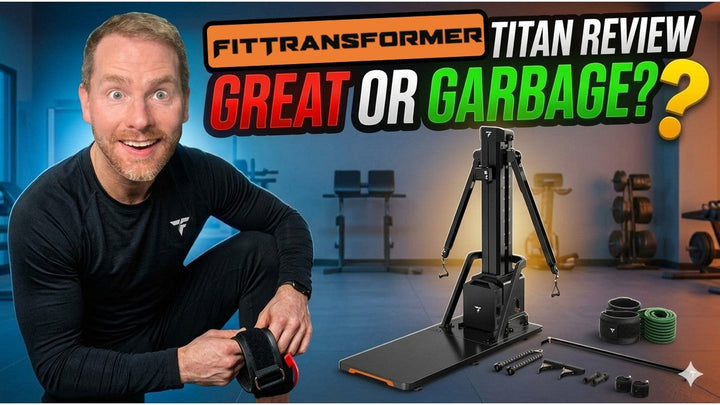
Standard carabiners allow users to change handles without staying inside a closed accessory ecosystem. The reviewed package included a connected bar, ankle straps, a triceps rope, and ski handles; current package contents should still be confirmed on the product page. Existing compatible cable attachments can broaden the exercise menu further.
The source test described occasional moments when a load change did not register or the motor failed to engage immediately. Backing out one menu level and confirming the selection restored operation. This was presented as a minor interface quirk rather than a workout-ending failure, but buyers who expect instant physical controls should weigh that behavior against the benefits of electronic modes.
The Trade-Offs to Consider
Fan noise is the clearest everyday compromise. The portable motor package needs active cooling, and the review described a continuous sound closer to a hair dryer on low than to a silent weight stack. Headphones or room music may mask it, but anyone training near a sleeping area or shared workspace should listen to the source video and decide whether the sound level is acceptable.
The system also requires wall power. It is not a battery-operated machine, so outlet position and cord routing belong in the room plan. Finally, long-term durability remains harder to judge than immediate cable feel. The source disclosure says the product was supplied at no cost for review, and the test period covered only short-term use. Current warranty coverage and service terms should therefore be checked directly rather than inferred from one test period.
Within those limits, cable travel was one of the stronger first-hand impressions. The source test rated smoothness around eight to eight and a half out of ten and placed the Titan among the smoother electronic cable systems the channel had used. That is a subjective observation, not a universal measurement, but it helps explain why the machine remained appealing despite the fan and interface quirks.
Who the Titan Suits
The Titan makes the most sense for a buyer who wants a compact functional trainer, values both strength and ski-style conditioning, and prefers straightforward hardware over a subscription-led platform. It is also relevant to renters, people with crowded training rooms, and users who want to explore eccentric training or assisted repetitions without buying specialized equipment for each method.
It is a weaker fit for someone who prioritizes silent operation, battery power, instructor-led classes, or a large entertainment display. Heavy lifters should compare the per-side resistance and available exercise setup with their current loads, while beginners should budget time to understand the menus and arm adjustments. The right decision depends less on the word smart and more on whether the machine's resistance range, working footprint, sound, and controls match the way the household will train.
What To Know Before Buying the FitTransformer Titan
Q1. Does the FitTransformer Titan require a subscription?
No. The reviewed configuration was designed to provide its core strength and ski functions without a required coaching subscription.
Q2. How much resistance does the Titan provide?
It provides up to 264 lb total, or roughly 132 lb per side when the selected load is divided evenly between two handles.
Q3. Can the Titan be used in a rented home?
Yes. It is freestanding and does not require wall mounting, but the user still needs a suitable floor, working clearance, and access to an outlet.
Q4. Does it include a bench?
No. A bench was used in the source demonstration, but it was not included with the reviewed Titan package.
Q5. Is the FitTransformer Titan quiet?
No. The active cooling fan was the most noticeable drawback in the source test, so noise-sensitive buyers should evaluate the video audio before purchase.